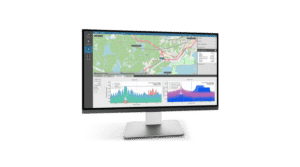
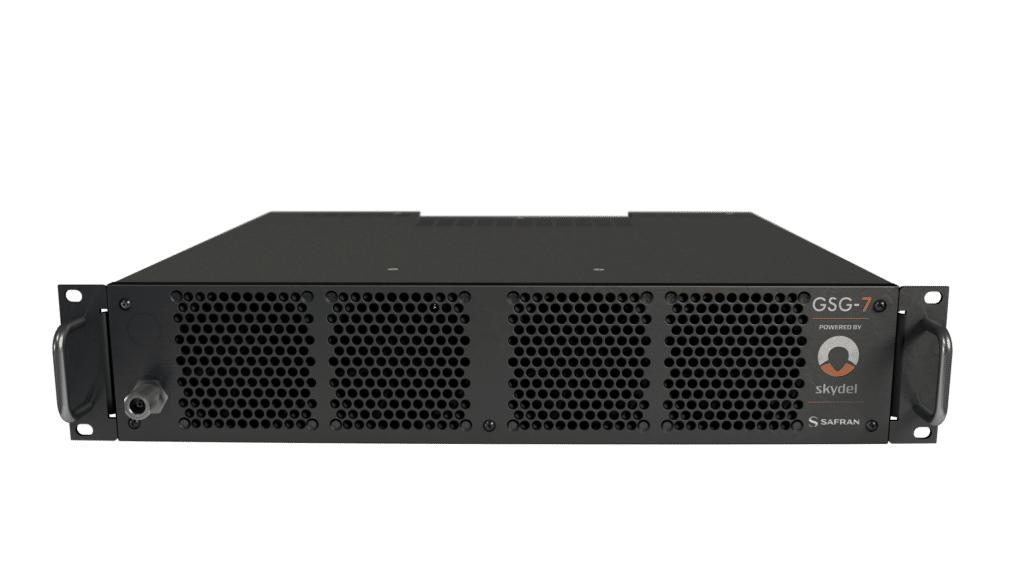
Skydel GSG-7 Advanced GNSS Simulator
High Performance and Capability Made Easy
GSG-7 is redefining the GNSS simulation industry with its easy-to-use simulation capabilities, extraordinary flexibility and high signal capacity.
This positioning, navigation, and timing test solution offered through Safran’s family of Skydel-based simulators delivers the highest standard of Global Navigation Satellite System (GNSS) signal testing and simulation in an easy-to-use, turnkey, small form factor. This advanced GNSS simulator enables you to generate the same RF signals as real satellites, allowing you to test your GPS / GNSS receiver device in any scenario.
Using the robust and innovative 1000Hz Skydel software engine and commercial-off-the-shelf (COTS) software-defined radios (SDRs), GSG-7 easily outperforms the competition.
ADVANTAGES
Low Latency HIL
Low latency HIL testing is an essential step in the verification process of the Model-Based Design (MBD) approach. HIL testing is usually the last step before testing in the field and after Model-In-the-Loop (MIL), Software-In-the-Loop (SIL) or Chipset-In-the-Loop (CIL). This step is critical because it involves all the hardware and software that will be used operationally. Skydel’s low latency HIL simulation can test a standalone Device-Under-Test (DUT) or, more generally, an entire complex system consisting of multiple DUTs.
Scalable Automation
Need to run multiple tests at scale? Take advantage of Skydel’s robust automation capabilities. The Skydel API allows you to automate just about any command within the GUI, including the customization of plugins and scripts. This means that if your test plan requires a sequence of multiple simulations with slight variations, you can set up a series of tests to perform in a sequence – controlling the parameters of each simulation, the duration, and the location of each test.
High-End Performance
With a 1000 Hz simulation iteration rate, the GSG-7 allows you to set up and run advanced simulations. Whether you need to create an aerospace simulation that involves dynamic trajectories or even a hardware-in-the-loop scenario that requires inputs from external sources or sensors, the GSG-7 simulator will enable you to thoroughly test your GNSS receiver device.
Satellite Simulation Made Easy
Simulate hundreds of satellites and satellite signals in real-time. Control every aspect of your simulation: the number of satellites, the strength of the transmitted signals, atmospheric conditions and more. Powered by Skydel software, our simulators help you recreate real satellite signals and broadcast them straight to your receiver device. This allows you to test how your receiver device will react in the real world – based on the exact parameters that you set.
USE CASES
-
Multi-Antenna GNSS Simulation for Unmanned Aerial Vehicles (UAVs)
Safran’s Skydel GPS/GNSS Simulators enable cost-effective, scalable multi-antenna testing for UAV applications.
-
Multi-Antenna GNSS Simulation for Automotive Applications
Safran’s Skydel GPS/GNSS Simulators enable cost-effective, scalable multi-antenna testing for automotive applications.
-
Hardware-in-the-Loop (HIL) Testing for Automotive Applications
Orolia’s Skydel GPS/GNSS Simulators enable repeatable, thorough drive testing
CASE STUDIES
-
Safran’s GSG-8 GPS/GNSS Simulator Trains Pilots to React to Real-World Situations
Military aviation programs provide standard pilot training to ensure that they can handle fighters, drone swarms and other advanced threats. But as they run complex flight training scenarios and face off against live and virtual adversaries, what may be overlooked is the value of using GPS/GNSS simulation to duplicate actual cockpit instruments, rather than relying…
REQUEST A QUOTE

FEATURES
- 700 signals
- Small size – 2U Rack-Mountable or Bench Top
- All MF/MC signals via a Composite port
- Available in three configurations with up to 3 SDRs
- Nanosecond-level synchronization between RF bands
- High-end RF quality
- All-in-view satellites simulation, all GNSS constellations
- 1000Hz simulation iteration rate
- Low latency HIL
- Live sky time synchronization
- RTK
- High-end performance (precision, resolution, ultra-high dynamic motion)
- Comprehensive and intuitive API (Python, C# and C++)
- Hardware-in-the-loop (HIL) integration
- IQ file generation & playback
- Basic interference
- Multipath Models
- Create custom signals
- RF Bands: 1-3
Maximum bandwidth 100 MHz (per radio) - Signals:
- GPS: L1-C/A, L1C, L1-P(Y), L2-P(Y), L2C, L5;
- NavIC L1, L5, S-Band;
- GLONASS: G1, G2;
- Galileo: E1, E5a, E5b, E6, E6PRS, E6 HAS, E5AltBOC, PRS (restricted signals), PRS-Noise, HAS-Noise; OSNMA
- BeiDou: B1, B2, B1C, B2A, B3I;
- QZSS: L1-C/A, L1 C/B, L2C, L5, L5S
- SBAS (L1/L5): WAAS, EGNOS, MSAS, GAGAN, SDCM
- Xona: PULSAR X1, X5
- Custom Signals
- Custom Constellation

INTERFACES
- Single RF Output: N-Type
- 10 MHz output: BNC
- 1 PPS output: BNC
- 10 MHz input: BNC
- 1 PPS input: BNC
- Antenna input: SMA
- HDMI, USB, Ethernet ports
SPECS
- Size: 2U
- Weight: 11.5 kg (25 lbs)
- Width: 48 cm (19 in)
- Depth: 41 cm (16 in)
- Height: 9 cm (3.5 in)
- Power Consumption: 400W
- Line Voltage: 100-240VAC, 50-60 Hz +/- 10% from IEC60320 (option O) connector;
- Temperature: +0C to +40C (operating), -15C to +50C non-condensing @ 12,000M (storage)
- GPU: 1