
SecureSync® Time Server

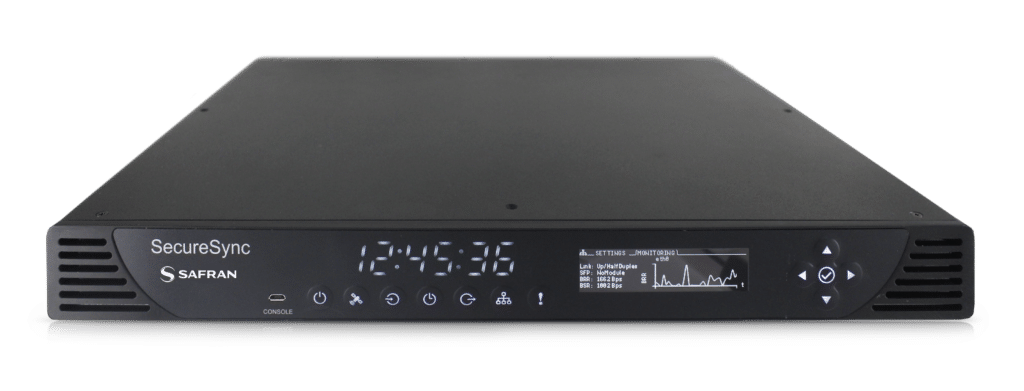
The SecureSync 2400 is a reliable and modular GNSS / GPS time server. It can output both 10MHz frequency as well as pulse-per-second PPS signals and PTP. The SecureSync 2400 is designed to synchronize critical defense and commercial infrastructures that require extreme reliability and security.

Get Quote
 

Do you need to synchronize all the nodes across network? Do you need precise timestamping for a financial application? Do you need a master clock time signal for your distributed radar equipment? If you have any precision-timing requirement for your network, then the SecureSync 2400 time server is for you.

The SecureSync® 2400 delivers precise time, and it also does much more than that. It transforms it from a hidden dependency into a resilient, secure, and regulation‑ready infrastructure service, purpose‑built for defense and critical infrastructure markets confronting both technical and regulatory evolutions.

SecureSync 2400
SecureSync 2400 is a highly configurable platform

Modular Time Server

Both defense and commercial infrastructure systems have been deployed for decades, and in that time frame, the standards, interfaces, and network threats continue to evolve. This means that static, single‑purpose timing appliances rapidly become obsolete.

With a highly modular and field‑upgradeable design, supporting dozens of option cards and multiple oscillator classes, SecureSync 2400 synchronizes sub-systems both through legacy timing interfaces and through network interfaces. Operators can adapt timing performance, interfaces, and redundancy models without replacing the entire system reducing lifecycle risk and total cost of ownership.

Get Quote

Resilient Timing Architecture Against GNSS Interference

Most modern infrastructures rely heavily on GNSS as a primary time source, yet GNSS signals are fragile and easily disrupted—whether unintentionally or through deliberate interference. Loss or degradation of GNSS can cascade into network outages, service disruption, or loss of operational synchronization.

SecureSync 2400 implements a layered‑defense timing architecture, combining multi‑band, multi‑constellation GNSS reception with optional interference detection, high‑performance internal oscillators and fallback to network time references (PTP, White Rabbit). This ensures continuity of accurate time distribution during GNSS disturbances and aligns with resilience principles promoted by authorities.

Time Servers

Cybersecurity-Driven Design

SecureSync 2400 is designed with security as a foundational requirement, not an add‑on. It protects against 2 security threat entry points: network threats and GNSS signal interference threats.

SecureSync 2400 integrates a FIPS 140‑3 certified cryptographic module, used for all authentication and cryptographic functions.

Scaling Network Time Distribution Across Diverse Networks

Critical infrastructures increasingly span hybrid and large‑scale networks, mixing legacy systems, IP networks, high‑precision Ethernet, and geographically distributed sites. Timing architectures must scale without sacrificing accuracy or resilience.

The SecureSync® 2400 Advantage

SecureSync 2400 supports a full range of timing protocols—from NTP and PTP to White Rabbit—and scales from small protected networks to very large deployments, handling thousands of client and a million of PTP requests per second. Optional network cards add multiple 10 GbE ports, enabling future‑proof network timing architectures.

SecureSync 2400 delivers high‑performance, scalable network timing to support small protected networks as well as large, distributed infrastructures.

SecureSync is the key enabler of a highly available time and frequency synchronization distribution architecture.

It adapts to demanding infrastructure environments, with extended temperature support (-20°C to +65 °C). Time distribution to legacy systems can be achieved with a range of synchronization signals, while timing protocols (NTP, PTP) are available for synchronizing of recent systems through the networks. Configure to your needs with the ability to extend the number of option cards up to six per unit. And, alternative signals including LEO PNT are available.
Complying with Operational Regulations

Regulations such as EO13905 (US) Cyber Resiliency Act (Europe) require operators of critical digital systems to demonstrate availability, integrity, monitoring, and recoverability of core services—including timing. Timing systems are no longer “invisible infrastructure”; they are auditable elements of operational resilience.

SecureSync 2400 is secure‑by‑design, featuring strong access control, authentication, encryption, audit logging, signed software updates, and a FIPS 140‑3 certified cryptographic module. These capabilities support compliance with European and US resilience and cybersecurity frameworks, making SecureSync 2400 a defensible component of regulated architectures. A rich set of APIs makes it easy to tightly monitor SecureSync 2400 operation – which can be efficiently implemented with PNT360 monitoring application.

Get Quote

USE CASES

  • Tiqker™ & SecureSync® Synchronization Over WR Long-distance Links

    The modern time and frequency synchronization of architecture has become a critical component for infrastructures that require extreme precision, low latency, and large-scale temporal coherence.

    View Use Case

  • Resilient, Secure, and Scalable: The SecureSync® 2400 Advantage

    Overview Modern defense and critical infrastructure operators face a growing set of timing‑related challenges driven by digitalization, increased reliance on GNSS, and tightening regulatory scrutiny. Precise and trusted time has become a foundational service for communications networks, energy grids, transportation systems, data centers, financial platforms, and military operations. At the same time, these environments are…

    View Use Case

  • Timing and Synchronization in Distributed Control Systems (DCS)

    In Distributed Control Systems (DCS), precise time synchronization is pivotal for ensuring coordinated operations across multiple control systems and locations.

    View Use Case

REQUEST A QUOTE