


Why Military Platforms Need High Precision Inertial PNT
Military vehicles – both in the sky and on the ground – need ways to navigate and synchronize their communications continuously and uninterrupted throughout the entire course of the mission. Encrypted satellite signals, such as M-Code and the legacy P(Y)-Code provide vehicles with military-exclusive L1 and L2 frequencies, which offer stronger resistance to jamming or spoofing. However, when missions are critical, relying solely on satellite signals creates a vulnerability and a single point of failure. To account for this, defense operators are implementing backup sources of PNT, (positioning, navigation and timing), including inertial PNT to ensure mission assurance.
For many platforms, conventional GNSS-enabled navigation is sufficient during routine operations. However, military missions increasingly occur in contested environments where jamming, spoofing, signal degradation, or complete GNSS denial are realistic threats.

Inertial Navigation Systems To The Rescue
This is where high precision inertial navigation systems play a central role. Unlike satellite-based navigation, inertial systems are self-contained and continuously calculate position and movement using onboard sensors. They have the ability to receive GPS data at the onset of a mission, but once their starting position is known, they do not rely on GPS or GNSS satellite signals.
The inertial navigation systems are comprised of both accelerometer sensors as well as gyroscopes to detect movement and velocity in specific directions as well as orientation.
Because they do not rely on external signals, they continue operating even when GNSS is unavailable or compromised. Safran’s inertial navigation systems are specifically designed to deliver reliable guidance and navigation performance in GNSS-denied environments across air, land, sea, and autonomous platforms.

Because they do not rely on external signals, they continue operating even when GNSS is unavailable or compromised. Safran’s inertial navigation systems are specifically designed to deliver reliable guidance and navigation performance in GNSS-denied environments across air, land, sea, and autonomous platforms.
Mission Demands Are Driving Higher Accuracy Requirements
Military platforms today are expected to do more than simply navigate from one point to another. They must support artillery pointing – as is the case with the Geonyx – as well as help feed data to on-board computers for sensor fusion, and act as a central master clock time source for networked warfare, and synchronized mission execution.
The same trend extends to radio communications and radar missile defense systems. In order to communicate on the same frequency, or synchronize an array of air defense radar dishes, military personnel need a time server that is resilient. Resilient time and frequency reference systems are able to use multiple sources for the time signal, through GPS or other GNSS constellations, and also can switch to backup sources in case of a signal outage or attack. They can use internal oscillators that maintain the heartbeat of the time source without drifting too much to compromise the mission.
Resilience Matters as Much as Accuracy
Historically, military navigation systems were primarily evaluated based on accuracy – i.e. the phase error and how many microseconds error away from the UTC time source. Today, resilience is equally important. Even the term “PNT” has been modernized to R-PNT, meaning resilient PNT or A-PNT assured PNT to engineer devices and equipment to be resilient against the constant evolving threats.
Advanced inertial navigation systems provide a trusted source of navigation data regardless of the external environment. They enable military platforms to maintain operational continuity during jamming, spoofing, or signal outages while reducing dependence on vulnerable external infrastructure. Safran’s inertial navigation solutions are engineered to provide highly accurate performance and reliability across a broad range of military applications, including armored vehicles, military helicopters, autonomous systems, and other mission-critical platforms. There is an inertial navigation system designed specifically for aerial vehicles, land vehicles, as well as naval vessels.
-

Geonyx™ Inertial Navigation System
- Artillery Inertial and Pointing System
- Pointing accuracy < 0.5 mils at high latitude
- Automatic detection of GNSS jamming, spoofing and meaconing
-
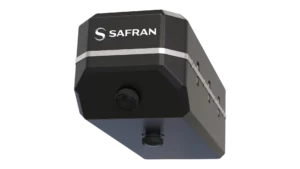
DRAGN™
- In-house technology
- ITAR Free
- High-accuracy, low-SWaP-C
-

BlueNaute® Inertial Navigation System
- Gyrocompass, Attitude & Heading Reference System
- 200,000h MTBF
- International Maritime Organization (IMO) Certified
Have specific questions about Inertial Navigation Systems or need expert advice?
If you have a question about inertial measurement units or would like a quote, contact us today.
Preparing for the Next Generation of Military Operations
As military platforms become more autonomous, connected, and precision-focused, the demands placed on positioning navigation and timing systems will continue to increase. Program managers and systems engineers must evaluate navigation architectures not only for current mission requirements but also for future operational challenges.
High precision inertial PNT is no longer a specialized capability reserved for select programs. It has become a foundational technology for enabling resilient military navigation, supporting tactical UAV systems, improving artillery platform guidance, enhancing missile guidance systems, and strengthening capabilities across space and missile defense missions.
In an era where access to GNSS can no longer be guaranteed, military platforms need navigation systems that remain accurate, available, and trusted under any conditions. High precision inertial PNT provides that assurance.
Contact Us Today For A Quote Or More Information
Don’t rely on a single source for your positioning, navigation and timing technology. Contact us today for more information.
 Related Resources
 Adapt