


Delivering Nanosecond-Accurate Time Across the Czech Republic with White Rabbit
Summary
CESNET, the Czech National Research and Education Network, is deploying CESTime, a nationwide fiber-based precise-time distribution network providing resilient synchronization traceable to the Czech national reference time, UTC(TP).
At the heart of the network, Safran WR-Z16 White Rabbit switches provide the precise synchronization backbone, enabling nanosecond-level time distribution across CESNET’s geographically distributed Points of Presence (PoPs).
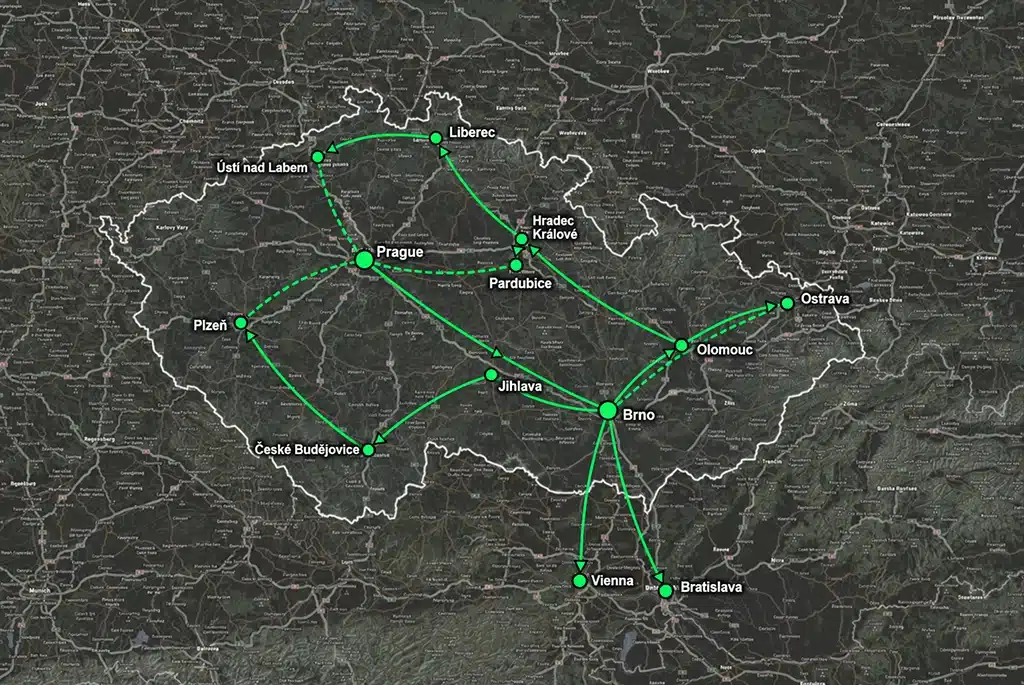
Running in parallel with CESNET’s existing IP infrastructure, CESTime uses dedicated optical channels on fiber already deployed for data communications. The network spans approximately 3,785 km, with 13 main nodes and 26 links organized into four redundant rings.
By combining CESNET’s nationwide fiber infrastructure with Safran’s White Rabbit synchronization technology, CESTime provides a terrestrial alternative for applications that require highly accurate, traceable and resilient timing without relying exclusively on GNSS.
Initially serving the Czech science and research community, the infrastructure is designed to support a broader range of users and critical applications, including government and industrial sectors.
CESTime Country Wide Network
Background / Requirements / Challenges
As digital infrastructures become increasingly distributed and interconnected, access to accurate and trustworthy time synchronization has become critical.
At the same time, the increasing occurrence of GNSS jamming and spoofing in Europe is reinforcing the need for complementary terrestrial sources of precise time.
CESNET has provided advanced network and connectivity services to the Czech science, research and education community since 1996. The company has therefore set out to develop a nationwide service capable of distributing time traceable to UTC(TP) and contributing to the resilience and sovereignty of the Czech Republic’s timing infrastructure.
The project presented had to deliver nanosecond-level synchronization over thousands of kilometers of fiber, while providing the reliability and redundancy required for continuous operation.
The key challenge lies in calibrating each link by managing fiber asymmetry across a redundant, multi-path topology.
It also had to support particularly demanding scientific applications: some CESNET users, including those involved in high-energy physics, require synchronization performance beyond that typically obtained from conventional GNSS-based timing.
Finally, the solution had to remain economically sustainable. Rather than deploying or leasing an entirely new fiber infrastructure, CESNET chose to use available optical channels within its existing fiber network, allowing precise-time distribution to operate alongside its conventional data network. several challenges.
Solution Provided / Product Used
CESNET chose White Rabbit as CESTime’s core technology, combining sub-nanosecond time transfer with standard Ethernet infrastructure. Compatibility with IEEE 1588 PTP and Synchronous Ethernet supports flexible integration into the wider network architecture.
This nationwide deployment uses Safran WR-Z16 switches, whose high port capacity supports distribution to multiple applications from each main Point of Presence.
Deployed throughout the timing backbone, these devices provide the accuracy and robustness required for continuous operation between geographically distributed sites.
This initiative builds on Safran’s participation in the CLONETS-DS project, which helped define architecture for European and national time-distribution networks. It also illustrates the terrestrial timing layer envisaged within the emerging European Complementary PNT (C-PNT) ecosystem. Assessment performed by the JRC, DG DEFIS and ESA have identified White Rabbit as a candidate technology for complementing GNSS within a European terrestrial time-distribution backbone. By distributing traceable time over fiber, it can reduce the exposure of critical infrastructure to GNSS jamming and spoofing while improving service continuity. CESTime provides a strong example of how this approach can be implemented on a national scale using existing telecommunications infrastructure.
CESNET complements the Safran equipment with its own CzechLight bidirectional optical amplifiers. These extend the timing signal across long-distance optical links while allowing the WR-Z16 switches to remain located at the main PoPs. Using survey features developed by Safran for the WR-Z16, CESNET has refined link calibration and monitoring to ensure accuracy along the network.
The result is a dedicated terrestrial timing layer capable of distributing a trusted national time reference independently from the conventional data traffic carried by the network.
The four-ring topology provides multiple redundant paths across the nationwide infrastructure, preventing a single link or node failure from interrupting time distribution. Then Safran’s new seamless switchover feature will automatically redirect synchronization traffic to an available path while maintaining timing continuity and accuracy. This enables the network to recover from failures without manual reconfiguration or service disruption for end users.
Performance Evaluation / Results
CESTime is currently operating in pilot mode, delivering timing services to users in the Czech science and research community while CESNET continues to validate technical parameters, operational processes and long-term performance.
Initial results demonstrate a stable network and nanosecond-level synchronization across the infrastructure.
The CESTime network targets a deviation of ±20 ns from UTC(TP) and ±5 ns between network nodes/PoPs. For monitored White Rabbit connections, an estimated deviation of approximately 3 ns relative to the serving PoP is expected.
Preliminary results indicate performance around the 1 ns level, providing sufficient margin against the targeted service requirements. However, further measurements are needed to characterize performance across different temperatures, weather conditions and operating environments.
Through the integration of Safran WR-Z16 White Rabbit technology, an existing nationwide fiber network can be transformed into a highly accurate and resilient time-distribution infrastructure.
This architecture combines the respective strengths of both organizations: CESNET’s nationwide optical infrastructure and expertise in advanced networking, and Safran’s expertise in resilient, high-precision timing and synchronization.
Beyond its initial scientific applications, the project establishes a foundation for extending precise, traceable and GNSS-independent timing to government, telecommunications, energy, industry and other critical infrastructures.
 Related Resources
 Adapt