

Q&As:
Enabling Advanced GNSS Receiver Validation with Wavefront Simulation
with Quentin Ceruti, GNSS Signal Simulation Product Manager

Q: To start, can you explain what wavefront simulation means in the context of GNSS testing?
A: Wavefront simulation is about validating spatial truth, not just signal availability. Instead of injecting GNSS signals into a single RF input, it recreates how signals physically arrive at a multi element antenna system, including phase, relative delay, and angle of arrival across each element.
This distinction is essential for CRPA based receivers, where performance depends on spatial processing. Wavefront simulation ensures that the receiver experiences a geometrically and temporally correct RF environment – something traditional single antenna simulation simply cannot deliver.
Q: What has changed in GNSS receiver design that makes wavefront simulation essential today?
A: GNSS architectures are evolving rapidly. Multi element CRPA systems are now standard in defense and aviation and becoming mainstream in commercial applications that demand resilience.
These systems rely on beamforming, null steering, and angle of arrival estimation to counter interference. Validating those techniques requires a test environment where threat direction, dynamics, and density can be tightly controlled and repeated. Wavefront simulation makes that possible, reducing reliance on expensive, unpredictable, or even impossible field testing while providing deeper insight into system limits.
Q: What are the main technical challenges, and how are modern systems addressing them?
A: The defining challenge is maintaining phase coherence and timing alignment across channels. Even minor inconsistencies can invalidate spatial processing results.
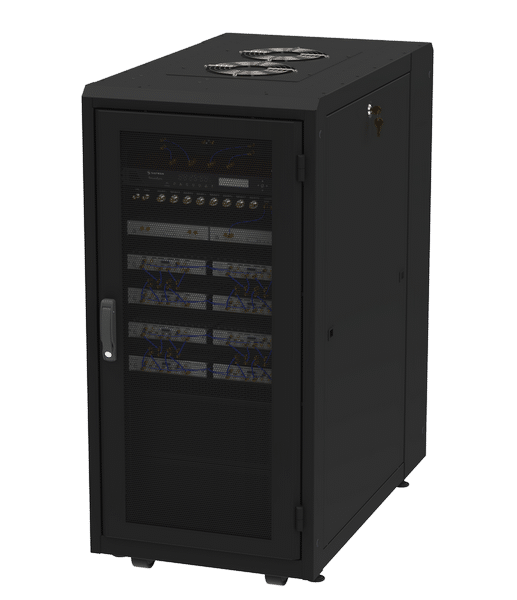
Safran Electronics & Defense addresses this with its GSG Wavefront solution, a software defined CRPA test system built for phase coherent, multi channel simulation. Using a shared local oscillator architecture and continuous real time calibration, GSG Wavefront preserves alignment throughout dynamic scenarios. Powered by Safran’s Skydel simulation engine, it computes geometric delays and phase offsets in real time based on satellite motion, antenna geometry, and threat behavior.
This architecture is designed for conducted testing – connecting directly to CRPA antenna electronics – and complements OTA validation performed in anechoic chambers, giving engineers confidence that lab results reflect real world physics.
Q: Can you give a concrete example where wavefront simulation makes a real difference?
A: The clearest and most common example is CRPA anti jam and anti spoof validation. With Safran’s GSG Wavefront, engineers can inject authentic multi constellation GNSS signals into each antenna element while simultaneously introducing multiple jammers or spoofers from defined angles of arrival and with dynamic trajectories.
In a conducted test configuration, this allows precise assessment of null forming performance, tracking robustness, and position stability under extreme jammer to signal ratios. The same scenarios can later be exercised OTA in an anechoic chamber, validating antenna level behavior.
What would be nearly impossible to reproduce consistently in the field becomes routine in the lab. Wavefront simulation turns CRPA validation into a disciplined engineering process – one where limits are explored systematically instead of discovered by surprise or by accident.
Q: As GNSS resilience becomes mission critical, how should engineers be thinking differently about CRPA validation?
A: It’s all about confidence. Confidence must be earned through evidence. Wavefront simulation – particularly when integrated into a scalable platform like Safran’s GSG Wavefront – enables engineers to prove not only that a CRPA works, but why it works and where its boundaries truly lie.