

QUPIDO Project
Safran Electronics & Defense to pioneer quantum-ready timing networks for future space missions with ESA
QUPIDO will explore how deterministic timing and quantum communications can converge into a single optical infrastructure, paving the way for more secure, resilient and autonomous satellite constellations.
As satellite constellations become increasingly distributed and autonomous, the demands placed on space communications are rapidly evolving. Tomorrow’s missions will not only require ultra-high-speed optical links to exchange growing volumes of data, but also ultra-precise synchronization to coordinate distributed operations and quantum-secure communications to protect critical information.
Meeting all these requirements with separate payloads would increase spacecraft complexity, mass and power consumption.
To address this challenge, the European Space Agency (ESA) has selected Safran Electronics & Defense to lead QUPIDO (Quantum and PNT Intersatellite communications with Data AggregatiOn), a nine-month General Support Technology Programme (GSTP) Element 1 – De-Risk project.
Rather than developing flight hardware, the programme focuses on validating key technologies through a laboratory proof of concept, reducing technical risk ahead of future space-qualified systems.
Reimagining the optical backbone of future space missions
Today’s satellites generally treat timing distribution, optical communications and quantum communications as independent subsystems.
QUPIDO explores a different vision: a single free-space optical terminal capable of simultaneously transporting deterministic timing, conventional data traffic and future quantum communications.
At the heart of this architecture lies White Rabbit, the ultra-precise synchronization technology originally developed at CERN and now deployed worldwide across scientific facilities, telecommunications networks and critical infrastructures.
Unlike conventional synchronization protocols, White Rabbit distributes frequency and time simultaneously with deterministic latency and sub-nanosecond accuracy. Within QUPIDO, this common time reference enables spacecraft to coordinate every laser transmission and every detected photon – an essential prerequisite for combining classical optical communications with quantum technologies.
If successful, this approach could significantly reduce spacecraft Size, Weight and Power (SWaP) while improving resilience, simplifying architectures and enabling future quantum- ready satellite networks.

What is White Rabbit?
White Rabbit is an Ethernet-based synchronization technology capable of distributing frequency and time with deterministic latency and sub-nanosecond accuracy. Originally developed at CERN, it is now deployed in scientific facilities, telecommunications networks and critical infrastructures worldwide.

Three technologies, one shared vision
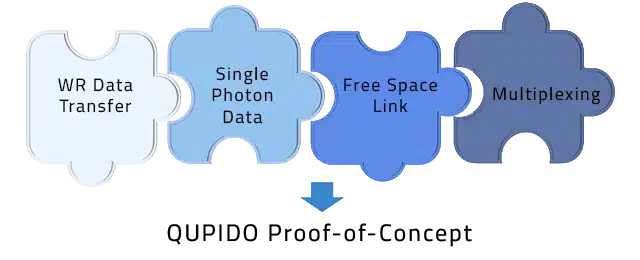
QUPIDO brings together three strategic technologies that will shape the next generation of space infrastructures:
- Deterministic timing, enabled by White Rabbit technology, providing the common time reference required for distributed space operations.
- Free-space optical communications, a key enabler for high-capacity inter-satellite networking.
- Quantum communications, preparing future space networks for Quantum Key Distribution (QKD) and next-generation cybersecurity, starting with single photon communication.
Together, these technologies could enable secure, resilient and quantum-ready optical networks for future space missions.
“Future space infrastructures will depend as much on trusted timing as on trusted communications”, explains Álvaro Arco, R&D Engineer at Safran Electronics & Defense. “White Rabbit provides the deterministic timing needed to coordinate quantum communications, while quantum technologies bring the security that future timing and PNT networks will require, Bringing both together over the same optical link is a key step towards simpler, more efficient and quantum-ready satellite networks”.
Combining deterministic timing and quantum communications
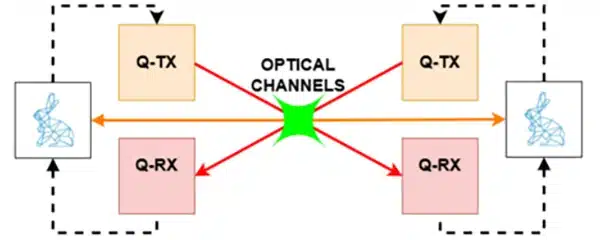
One of the project’s main objectives is to demonstrate that White Rabbit synchronization traffic and single-photon quantum signals can coexist over a shared optical link without compromising either system’s performance.
Within the consortium, Safran Electronics & Defense leads the deterministic timing architecture based on White Rabbit, while GRADIANT contributes its expertise in quantum optical communications through the development of the single-photon communication channel. Together, both technologies are integrated to validate their coexistence over a common optical infrastructure.
To achieve this, QUPIDO investigates two complementary multiplexing approaches:
- Wavelength Division Multiplexing (WDM), selected as the baseline integration strategy, allowing classical and quantum signals to travel simultaneously on different wavelengths.
- Time Division Multiplexing (TDM), evaluated as an exploratory approach for future implementations.
The laboratory demonstrator is primarily built using Commercial Off-The-Shelf (COTS) components, complemented by targeted FPGA and optoelectronic developments. This pragmatic approach accelerates development while identifying the technological challenges that will need to be addressed before future space qualification.
Ultimately, the project seeks to demonstrate that high-precision timing, conventional optical communications and future quantum services such as Quantum Key Distribution (QKD) can successfully share the same optical infrastructure.
Advancing the maturity of quantum-ready optical networks
Over the course of the project, our Spanish team of experts will coordinate the design, development and validation of the complete laboratory breadboard.
The activity progresses through four technical phases – from system requirements and preliminary design to development, integration, laboratory evaluation and final validation -supported by ESA’s key project reviews, including the System Requirements & Preliminary Design Review (SRR/PDR), Critical Design Review (CDR) and Final Review.
By the end of the programme, QUPIDO is expected to deliver:
- A laboratory demonstrator validating the coexistence of White Rabbit synchronization and single-photon communications;
- Validation of wavelength multiplexing as the baseline architecture, together with an initial assessment of time multiplexing;
- Technical recommendations and architectural guidelines for future space-qualified quantum optical terminals;
- An increase in the maturity of the key technologies from approximately TRL 3-4 to TRL 5, preparing a future ESA Engineering Model activity.

Why Quantum Key Distribution?
Quantum Key Distribution (QKD) enables encryption keys to be exchanged using single photons. Any interception attempt alters the quantum state, making eavesdropping immediately detectable and providing a new level of cybersecurity for future space communications.
Building Europe’s future quantum-enabled space infrastructure
Although QUPIDO is an early-stage technology activity, its ambitions extend well beyond the laboratory.
The concepts explored during the project directly support several strategic ESA roadmaps for optical communications, resilient Positioning, Navigation and Timing (PNT), and secure space connectivity. They could ultimately contribute to programmes such as OpSTAR, NAVISP, ARTES ScyLight, HydRON, and eventually Europe’s IRIS² secure connectivity constellation, where deterministic optical synchronization and quantum-secure communications are expected to play an increasingly important role.
Beyond Earth orbit, the same technologies could eventually support lunar communications, cislunar navigation and distributed scientific missions requiring precise synchronization independent of GNSS.
By combining European expertise in deterministic timing, photonics and quantum technologies, QUPIDO also strengthens Europe’s sovereign capabilities in next-generation optical space infrastructures.
As project coordinator, Safran Electronics & Defense brings its long-standing expertise in White Rabbit deterministic timing to a new frontier – helping shape future satellite architectures where precise timing, secure communications and resilient PNT converge into a single, integrated optical network.
Acknowledgments
- Álvaro Arco
R&D Engineer | Technology Exploration Unit. R&T -Safran Electronics & Defense, Spain - Trinidad Garcia
TEU Manager | Technology Exploration Unit. R&T -Safran Electronics & Defense, Spain - Gabriel Mª Carral López
Senior Research & Engineer at Gradiant - Miguel Ferreira Cao.
Head of Quantum Technologies at Gradiant