

News
New GNSS Receiver & Oscillator Configurations for SecureSync
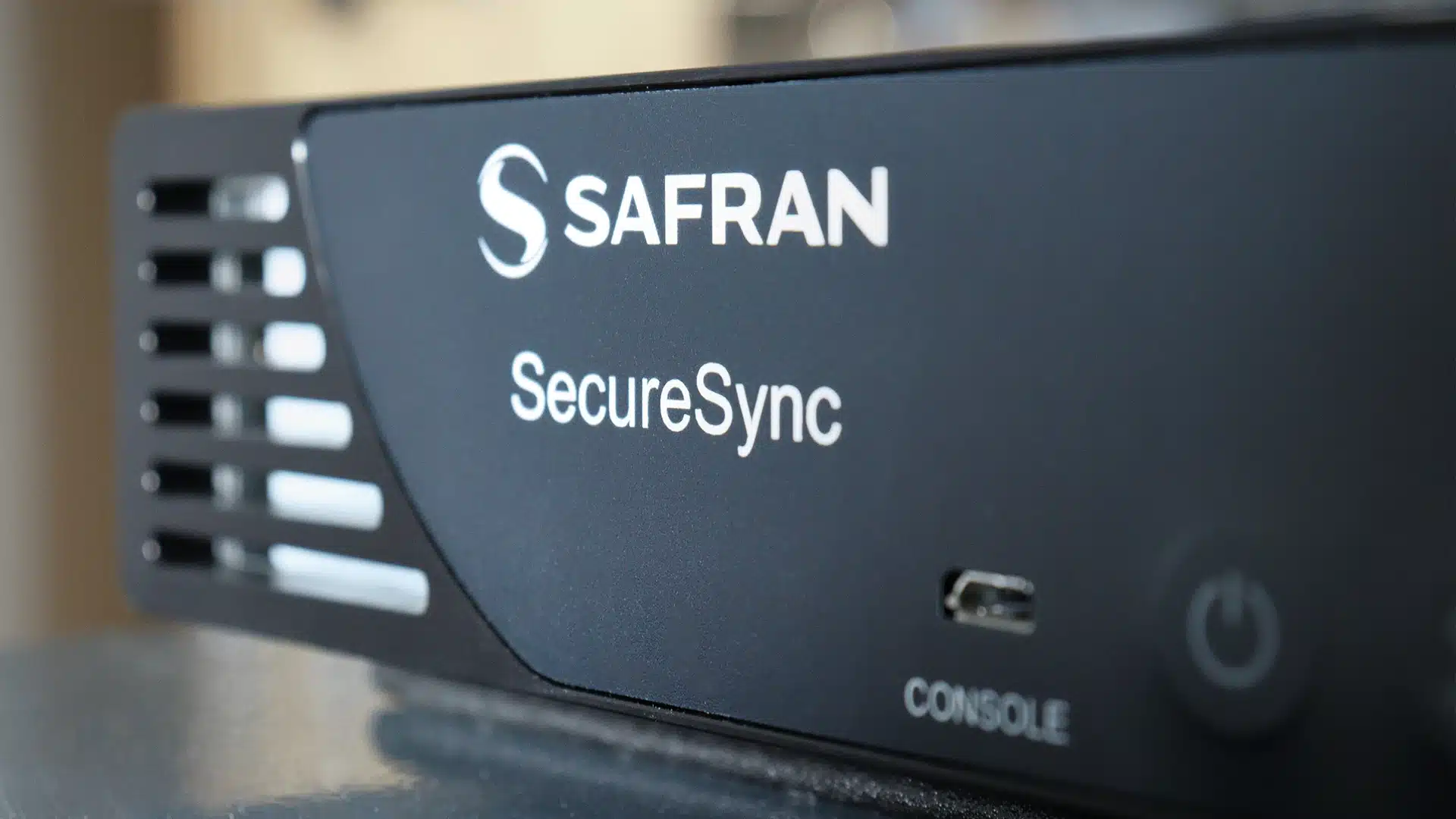
Safran’s SecureSync® 2400 time and frequency reference system has been enhanced with new capabilities designed to strengthen timing resilience and performance. As critical infrastructure operators face growing risks from GNSS disruption, alongside evolving cybersecurity requirements and network resilience standards, maintaining secure and reliable synchronization has become increasingly important.
To address these challenges, Safran has introduced new GNSS receiver and oscillator configurations for SecureSync, providing greater resilience, improved holdover performance and more robust access to GNSS signals.
Key Updates to the SecureSync
The key updates include:
- New oscillator configuration, including Medium Stability Oscillator (MSO) and High Stability Oscillator (HSO) MEMS-based options
- New GNSS receiver, which is an upgrade from single band (L1) to a multi-band (L1/L5), multi-constellation GNSS receiver
The new configuration of SecureSync translates to more frequency stability 1×10⁻⁹/day using the new MSO oscillator vs the older model TCXO which provided 1×10⁻⁸/day frequency stability. Similarly, the HSO oscillator option provides 2×10⁻¹⁰/day holdover frequency stability vs the older model 5×10⁻¹⁰/day from the OCXO.
This gives you longer holdover with higher precision when in free run mode so that you have more time to stay synchronized and find a backup time reference without losing network synchronization. The new MSO and HSO options also provide improved frequency stability and extended holdover performance across demanding operating conditions, including harsh environments.
The updated GNSS receiver F10T now comes with dual band reception and multi-constellation capabilities. With the new SecureSync configuration, you can now receive satellite signals from multiple constellations and in multiple frequency bands:
- L1 (GPS, QZSS), E1 (Galileo), B1 (BeiDou)
- L1, L5 (GPS, QZSS), E1 + E5a (Galileo), BeiDou (B2a), NavIC (SPS-L5)
This multi-band, multi-constellation capability enhances GNSS reception robustness and time reference accuracy, while providing greater diversity when GNSS signals are degraded or disrupted.
Safran’s Ongoing Commitment to Timing Technology Excellence

The latest SecureSync configurations reflect Safran’s ongoing commitment to keeping the platform aligned with today’s secure and resilient timing requirements, while preserving the core architecture that customers and partners already know.
The updates also help operators comply with evolving regulations and keep pace with demanding standards for critical infrastructure: If a regulation requires that your system have layers of redundancy to account for one satellite constellation going offline, for example, you will now be able to meet those requirements.
Multi-band GNSS reception improves the system’s ability to detect and mitigate interference, while also providing more robust reception and greater timing accuracy. At the same time, new MSO and HSO oscillator options provide improved stability across a wide range of operating conditions.
Together, these improvements bring some important system-level benefits. SecureSync can deliver better time and frequency performance, greater resilience when GNSS signals are disrupted, and extended holdover capability when an external timing reference becomes unavailable. These capabilities are increasingly important as GNSS interference is observed more frequently, including in areas where it would not traditionally be expected.

In other words, the system is better equipped to keep accurate time when conditions get difficult.
Same Architecture, Newer Capabilities
What’s important to note is that these enhancements have been introduced within the existing SecureSync architecture rather than through an entirely new platform. With a SecureSync purchase, you still get the same high degree of modularity, allowing you to build configurations suited to telecom networks, data centers, power utilities, aerospace, defense, and other critical applications.
This approach maintains form, fit and function continuity, helping enable a smooth transition for existing systems and programs. Current and new configurations remain part of the same SecureSync platform, while additional capabilities can continue to be introduced through regular firmware updates.
Along with the WROX option card, these new configurations support the continued growth and scaling of network timing infrastructures. SecureSync combines resilient synchronization, cybersecurity, monitorability and network integration within a modular platform designed to address timing requirements across numerous industries.
Explore how SecureSync is evolving to meet the next generation of timing challenges by visiting the SecureSync product page.
Connect With Us
To learn more about the new SecureSync upgrades or if you’d like to request a quote or more information, contact us today.
 Related Resources
 Adapt